
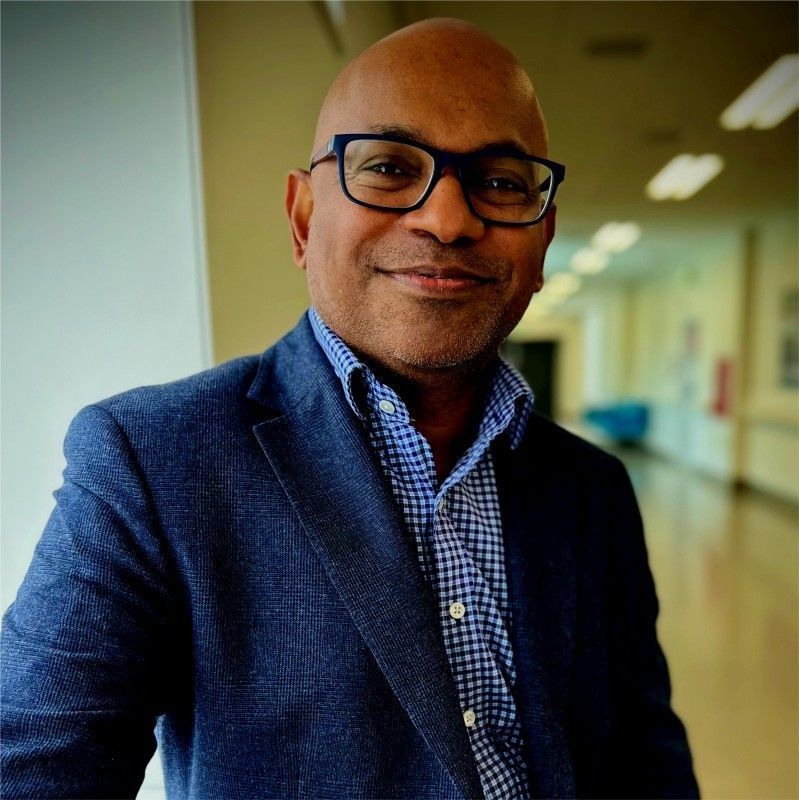
Tuesday August 11th, 2026 - Dr Rajesh Nair - Head of Department Cardiology - Waikato Hospital - AI and Your Doctor: How Technology is Changing the Way Medicine is Practised
Dr Rajesh Nair is a practising Cardiologist and health service leader who has worked across New Zealand and Australia, including several years leading the regional cardiology service at Waikato Hospital.
He holds an MBA from the Australian Graduate School of Management (UNSW) and is the founder of Briefly, a healthcare technology company using artificial intelligence to help doctors and patients.
In this talk, Raj will explore how AI is beginning to change the way doctors work — from clinical decision-making to how your medical letters are written — and what it means for patients. He'll share insights from the frontline of both medicine and technology, and offer a grounded perspective on what's hype, what's real, and what's coming next.
Blog article
AI in medicine: a cardiologist's view on trust, technology and the human touch
U3A Cambridge welcomed Dr Rajesh Nair, head of the Department of Cardiology at Waikato Hospital, to speak on the growing role of artificial intelligence in healthcare and what it means for patients. Dr Nair, who has also founded two health technology companies, opened by declaring his commercial interests before inviting the audience to hold him to the same standards he applies to AI itself.
A story to set the scene
Dr Nair began with the story of a Waikato farmer whose heart attack was detected by an ambulance machine that sent readings directly to his phone, allowing rapid treatment. He contrasted this with the hour he then spent entering the same information into hospital computer systems, illustrating his central theme: technology can help clinicians notice things faster, but can also get in the way of care.
Learning from history
Drawing a parallel with the invention of the stethoscope in 1816, Dr Nair noted that early sceptics doubted the device would ever become practical, yet it endured because it sharpened listening without replacing the doctor's judgement. He argued AI should be judged by the same test: does it help clinicians notice, understand and communicate better, or does it come between doctor and patient?
What AI can and cannot do
Dr Nair explained that modern AI learns patterns from vast amounts of data rather than following fixed rules, and can sometimes detect subtle signals in tests such as ECGs that humans may miss. He gave examples including a Swedish breast screening study where AI-assisted radiologists found 20 to 29 percent more cancers, and a smartwatch that flagged an irregular heart rhythm in a fictionalised patient, Margaret, leading to further investigation. In each case, he stressed, the machine only flagged a possible pattern, it did not diagnose, and a clinician still had to decide what the finding meant.
He warned that AI chatbots can "hallucinate", producing fluent but incorrect or invented information, and cautioned that AI-generated clinical notes have included medications or examinations that were never actually discussed. He noted that a US-developed heart valve screening tool used in Korea flagged 83 percent of patients as high-risk, when only 30 percent actually had the condition, causing unnecessary anxiety and further testing. He also cautioned that tools developed overseas may not perform reliably for New Zealand populations, including Māori and Pacific peoples, unless properly tested locally.
Risks and responsibility
Dr Nair was clear that responsibility for medical decisions must remain with clinicians, not machines, likening AI's role in medicine to "full self-driving" car systems, which still legally require a human driver in control. He cited a study in which doctors using ChatGPT scored better than those without it, and the chatbot alone scored higher still, but doctors working with the tool together outperformed the machine alone in a third of cases, reinforcing that human judgement adds value AI cannot replicate alone.
He also raised the danger of voice-cloning scams, where AI can imitate a family member's voice to request urgent money, and recommended families agree on a private "safe word" to verify identity before acting on any urgent phone request.
Advice for patients
Dr Nair encouraged audience members to use AI chatbots to help prepare for doctor's appointments, suggesting they ask the tool to explain a diagnosis or medical term in plain language and then request three good questions to ask their doctor. He stressed that chatbots should never be used to manage medical emergencies such as chest pain or stroke symptoms, where an ambulance should always be called immediately. He also advised patients to ask any health technology provider where their data is stored, whether it was tested on people like them, and who is accountable if something goes wrong.