
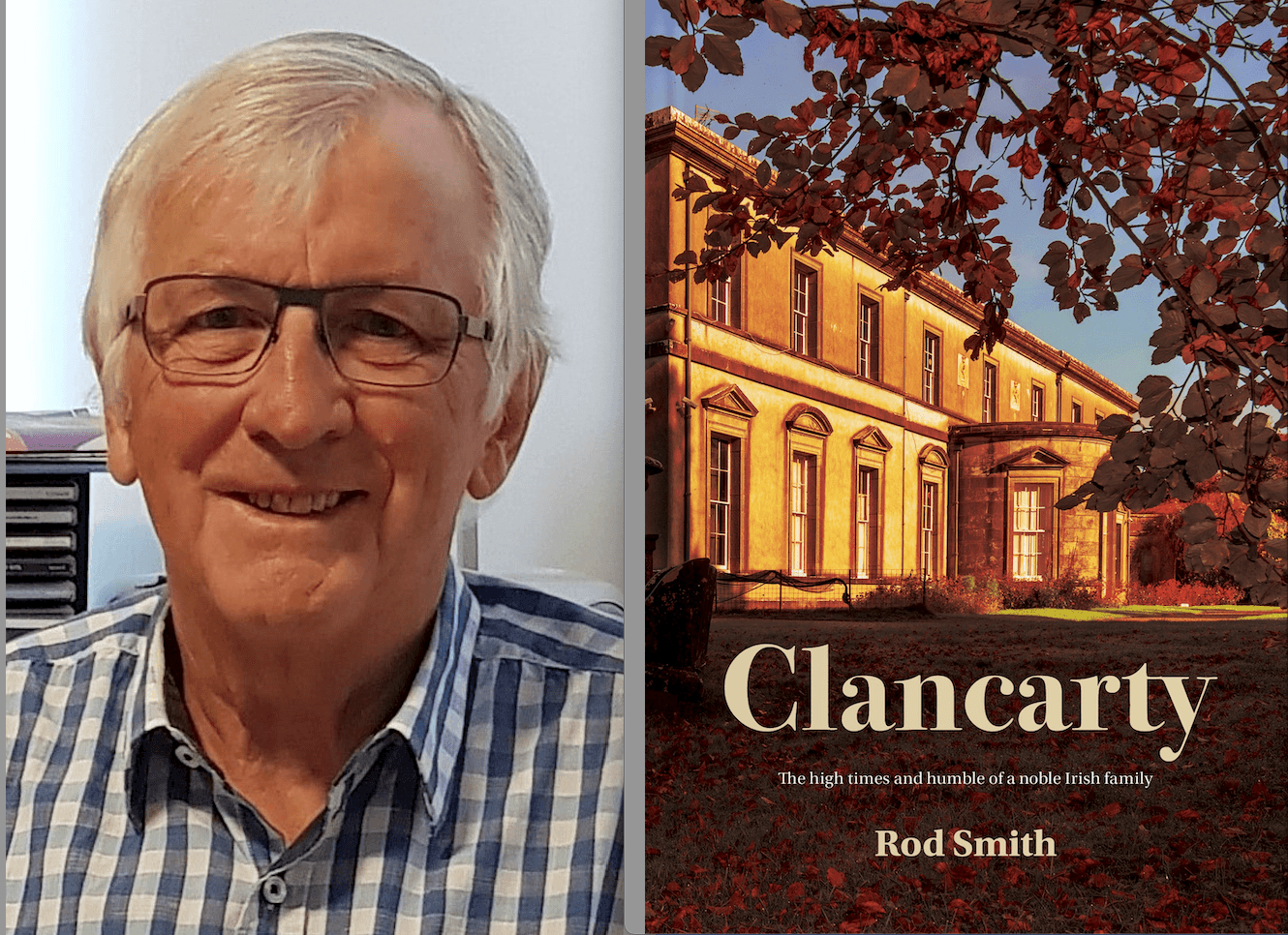
Tuesday October 27th, 2026 - - JOINT PARTNERSHIP HISTORY LECTURE -Rod Smith - From Galway to the Waikato Land War - A peerage family's connections
Rod Smith, family history researcher and writer, presents “Galway to the Waikato Land Wars - A Peerage Family’s Connections”.
Rod is a retired public servant, and former newspaper journalist and probation officer. His career included time crewing a cargo freighter, work in an English youth conference centre, and service in the Justice Department, Parliament, the Ministry of Defence, the Forest Service, and the Accident Compensation Corporation.
An avid family historian for over 35 years he has researched in depth his wife’s connections to landed Irish families, publishing his findings in two books – Guinness Down Under: the famous brew and the family come to Australia and New Zealand (2017) and Clancarty: the high times and humble of a noble Irish Family (2024). While researching Clancarty he discovered reports of the family’s involvement in the Waikato Land War of 1863-64 and a revealing speech given by the 3rd Earl of Clancarty in the House of Lords in 1864 on the subject of New Zealand race relations. Rod’s presentation will explore the events of 1863-64 and the several connections between the Earls of Clancarty and New Zealand.
Blog article - Colourful Clancarty family: Rod Smith on an Irish peerage family and New Zealand
At the U3A Cambridge meeting, guest speaker Rod Smith, a former journalist and public servant with more than 35 years of family history research, spoke about his latest book on the Trench family, the Earls of Clancarty, and their links to New Zealand.
How the research began
Rob's interest began when his mother-in-law pointed him to Burke's Irish Family Records. It showed his wife's ancestors included the Guinness, Trench and Minchin families, a fact she had not mentioned in 22 years of marriage. The book was launched in Ireland two years ago, at Ballinasloe in County Galway.
The Earls of Clancarty
Rod described the family as a mixed lot. They included a bankrupt earl who married an actress, a shrewd property developer, and an eighth earl who once had afternoon tea with Adolf Hitler. That earl later became a UFO enthusiast and campaigned in the House of Lords for government study of sightings. Rod also described the Famine-era burial ground at Bully's Acre, near the Ballinasloe workhouse.
Captain Frederick Trench and the Waikato War
Frederick Trench, second son of the third earl, served as a captain in the 40th Regiment in the 1863-64 Waikato War. Rod offered only one perspective on a complex subject. The campaign began on 12 July 1863 and involved about 12,000 imperial troops against around 4,000 Māori defenders. Rod's tally was about 100 British and 350 Māori killed.
Trench guarded the Great South Road and was praised for rescuing soldiers during an attack.
At Rangiriri (20 November 1863), eight British frontal assaults failed. The defenders' white flag was taken as surrender, and about 180 prisoners later escaped from Kawau Island.
The 40th Regiment took part in the controversial attack on Rangiaowhia (21 February 1864), where most of those killed were non-combatants.
The war ended with the confiscation of Waikato land under the New Zealand Settlements Act.
Trench owned racehorses, was promoted to major, and died in England in 1913. In the House of Lords in 1864, his father criticised the confiscation as unjust. Rod called this hypocritical given the family's record in Ireland. The 1995 Waikato-Tainui settlement, valued at $170 million, included a Crown apology.
The fifth Earl's visit
The fifth earl, William Frederick Trench, visited New Zealand for six weeks in 1889. His parents had sent him abroad after he secretly married the dancer Belle Bilton. He wrote home about racing, balls and heavy drinking. His father's later attempt to get William to divorce Belle failed in court, when he declared her love for her. The jury took 15 minutes to adjudicate and said 'no divorce', they remained married for 16 years until her death.
AI-enhanced photographs
Rod showed an AI-enhanced museum photograph of the officers' mess hut. He noted we cannot know whether such images are accurate. The museum representative explained that AI use is documented in image metadata because of concerns about artificial material entering collections.
Thank you and upcoming meetings
The chair thanked Rod who stayed afterwards to talk with members.
Tuesday 8 December: Dame Fiona Kidman talking about her career and writing, at Raleigh Street Christian Centre.
Next year, meetings move to the second Friday of each month at Raleigh Street Christian Centre. There is no meeting in January.
Friday 12th February: Tania Linford, an audiologist, on how the ears and brain work together.
Friday 12th March Rob Harley, a journalist, on life's most amazing people.