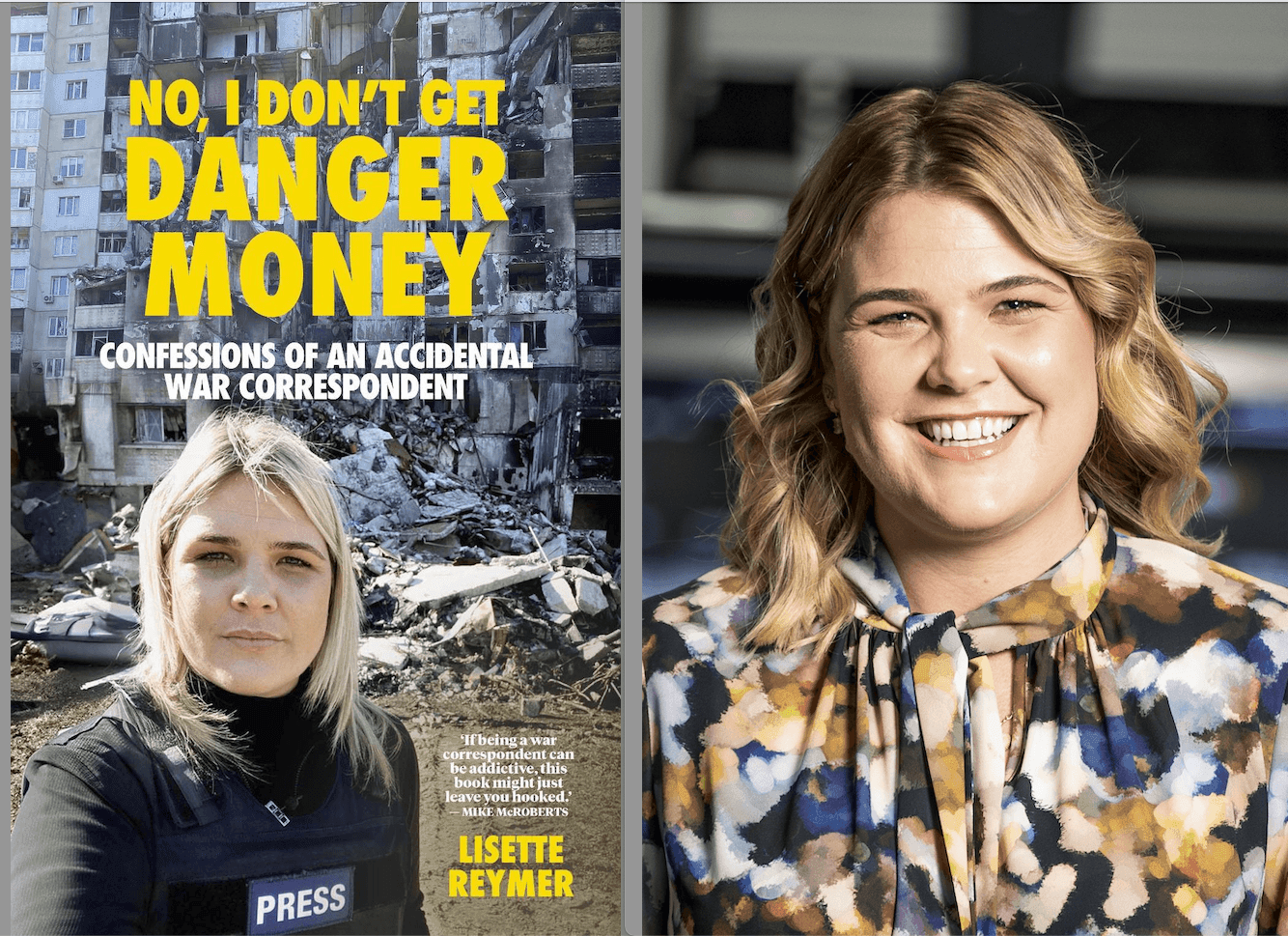
TUESDAY May 12th, 2026 - Lisette Reymer - No I don't get danger money
Lisette Reymer is a multi-award-winning journalist, one of New Zealand’s only war correspondents, and recognised as one of the country’s top storytellers.
In recent years, her life has been a blur of breaking news, border crossings, body armour, landmines and bomb shelters. Her reporting has even drawn the attention of the Russian President, who sanctioned her by name.
At 26, she became Newshub’s Europe Correspondent, covering major global events including the Ukraine war, Queen’s death, Israel-Gaza conflict, Trump’s indictment, King’s coronation, earthquakes in Turkey and Syria, the hunger crisis in Ethiopia, and more.
She’s won multiple journalism awards, including for her Ukraine coverage, and was named 2024 Reporter of the Year. Her book, No, I Don’t Get Danger Money, shares her wildest stories with brutal honesty and humour
From Cambridge farm to war zones: A journalist's extraordinary journey
Lisette Reymer, former Europe correspondent for Newshub, recently shared her remarkable career journey with U3A Cambridge members, taking them from her childhood on a Cambridge dairy farm to the front lines of international conflicts.
Early beginnings and career foundation
Growing up as the youngest of five children on a Cambridge dairy farm, Reymer always knew she wanted to be a journalist. The family's tradition of watching the 6pm news together each evening sparked her early interest in the industry. After completing high school and broadcasting school in Christchurch, she secured an internship at TVNZ, starting at the bottom with overnight shifts monitoring emergency service scanners.
Her career progressed through various roles at TVNZ before she made the strategic decision to move to TV3, believing that working in different newsrooms provided valuable variety and experience. This move proved pivotal when, at just 26 years old, she was offered the position of Europe correspondent - a role that would dramatically exceed her expectations.
Preparation for the unexpected
Initially expecting to cover politics and royal events, Reymer underwent hostile environment training in Kent with cameraman Daniel Hennett. The intensive course covered everything from dodging missiles and detecting landmines to medical treatments and wearing bulletproof vests. The training culminated in a mock kidnapping exercise, complete with interrogation scenarios designed to prepare journalists for extreme situations.
"The whole idea is that if you've experienced it once, even in an exercise scenario, maybe then a tiny, tiny bit of the edge will be taken off if it ever happens in real life," Reymer explained. (even though her cameraman gave up all their secrets quickly in the mock kidnapping exercise).
Ukraine coverage begins
As troops amassed on the Belarus border, Reymer and Hennett recognised the significance of the situation and persistently pitched to cover the story. Their self-driven approach to correspondent work meant preparing detailed proposals including logistics, safety measures, and financial considerations.
After US intelligence announced that Kyiv would be targeted with aerial bombardments, their editors initially hesitated but eventually approved the assignment on condition they acquired essential safety equipment: bulletproof vests, helmets, satellite phones, and GPS trackers.
Their first trip occurred before the war officially began, on what was likely one of the last flights into Ukraine for four years. Despite initial fears, locals remained calm and confident that invasion wouldn't occur. Two days after their departure, the war started.
Return to active war zone
Returning to Ukraine during active conflict required enhanced safety protocols, including carrying $10,000 USD in cash (withdrawn from ATM's in Poland in $300 lots) and employing two security officers instead of one. However, a security breach at the border saw one officer detained by Ukrainian soldiers due to holding a Belarusian passport, leaving them with reduced protection.
The active war zone presented a stark contrast to their first visit: checkpoints everywhere, trenches being dug in farmland, tanks hidden in foliage, and sandbags protecting strategic locations. The constant air raid sirens became a nightly routine, with residents regularly moving to bomb shelters.
Life-threatening incidents
Reymer recounted several dangerous situations, including getting lost during a nighttime air raid without proper accreditation, navigating through a hotel fire caused by an alcoholic guest experiencing withdrawal, and stepping over a landmine while following a Ukrainian family through their village.
One particularly tragic incident involved their bulletproof vehicle striking a small car, killing both occupants - a man with poor eyesight driving his wife away from the war zone. This tragedy motivated them to push harder for impactful stories but also led to some dangerous decisions.
Royal coverage and global assignments
Between war coverage, Reymer covered major royal events including the Queen's Platinum Jubilee and death. Newsrooms had prepared extensively for the Queen's death, with pre-written bulletins and strict protocols. The coverage lasted 11 days, requiring significant physical and mental endurance.
Her assignments expanded globally to include the Turkey earthquakes that killed 55,000 people, riots in Paris, famine in Ethiopia, Trump's indictment, and the King's coronation. Each assignment brought unique challenges and perspectives on human resilience.
Career conclusion and key lessons
Reymer's correspondent role ended when Newshub was shut down in 2024. The news came during a particularly challenging period, delivered via a work call just after they had completed coverage of a Ukraine anniversary and visited Auschwitz.
Reflecting on her experiences, Reymer shared her most significant lesson: "To be miserable is a privilege. To wallow is a privilege." She observed that in the world's toughest environments, people choose to generate joy wherever possible, picking flowers from mined fields or finding happiness despite devastating circumstances.
"I think that's been my big lesson, is to realise how valuable and how lucky we are to feel that joy and feel happiness and to actually cling to it when we have the opportunity to, rather than dismissing it and holding on to the wallow," she concluded.
The presentation provided U3A Cambridge members with an intimate look at modern war correspondence and the personal cost of bringing global stories to New Zealand audiences.
You can buy Lisettes book through Paper Plus Cambridge.